Disclaimer: The information in this article is intended for informational purposes only and should not be taken as personal financial advice.
Warren Buffett is arguably one of the greatest investors of all time. As a long-term investor, I believe that it is prudent to study Warren Buffett as much as possible in hopes of absorbing some of his knowledge.
Lessons from How Buffett Does It
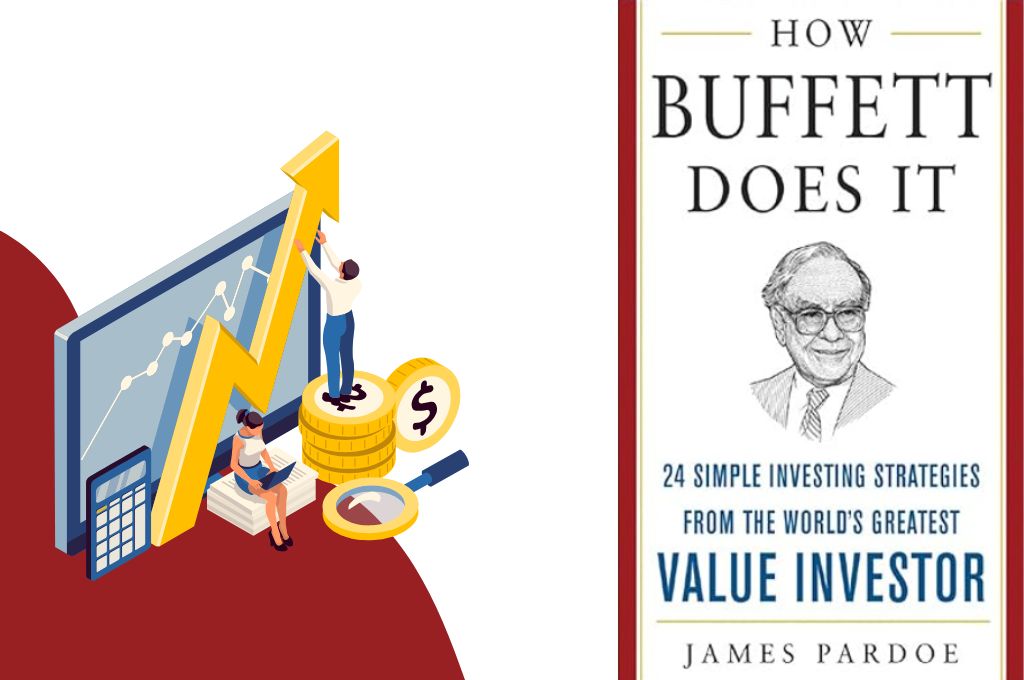
The book provides 24 investing lessons based on the analysis of Warren Buffett’s career. These are the 7 main lessons that stood out to me after reading this book.
Simplicity Over Complexity (Ch.1)
Invest with simplicity over complexity. Warren Buffett only invests in easy-to-understand businesses. He does not invest in anything that he does not understand. Investing should be based on “common-sense principles and patience” rather than “mathematical formulas, short-term market forecasts or movements, or charts based on price and volume”.
For retail investors who have full time jobs and do not have the time to analyze and track a portfolio full of stocks, I believe the best way to practice this principle is to invest in low cost exchange traded funds (ETFs) that track the US stock market such as SPY or QQQ. If you find index funds too boring and are trying to beat the stock market, I would recommend investing in leveraged versions of these ETFs (SPUU – 2x SPY; SPXL – 3x SPY; QLD – 2x QQQ; TQQQ – 3x QQQ).
Using the US stock market as your basis of investment (by investing in SPY or QQQ) is one of the simplest investments you can make. Over the last century, the US stock market has returned roughly 9-10% annually on average. Of course, there is no guarantee that the next century will have the same returns. But if you are a believer in the long-term growth of the US, then this is the way to go.
Maintain Proper Temperament (Ch.3)
Understand that investing entails risk. If you are not okay with seeing your account drop by at least 50%, then you should not be in the stock market. If you are in leveraged ETFs, expect drops over 90% during major recessions. If you are investing for the long term, these drops will happen as recessions are inevitable. The flip side of this is that your investments will return exponential gains if you can keep your cool and consistently invest during these downturns.
Concentrate Your Stock Investments (Ch.8)
Contrary to the popular investment advice of diversifying your portfolio with 50 or more stocks, Warrant Buffett recommends concentrating your portfolio by investing in 5-10 companies at a given time. “When you are convinced of a strong business’s prospects, be aggressive and add to your position rather than buying the fifteenth or twentieth stock on your list of possible investments.” Charlie Munger, Warren Buffett’s business partner, attributes the success of Berkshire Hathaway to “patience and non-diversification.”
From my past experience investing in individual stocks, I would have to agree with this. Over diversification of the portfolio, at least in my case, led to a lack of due diligence in researching the companies I was investing in and ultimately a poor investment performance. Since I currently have a full-time engineering job, I simply did not have the time to fully research and track 50+ companies. This experience is what led me to investing the majority of my portfolio in ETFs and leveraged ETFs.
Practice Inactivity, Not Hyperactivity (Ch.9)
Practice inactivity over hyperactivity when it comes to investing. Warren Buffett rarely makes adjustments to his stock portfolio; we are talking about 5-10 years before he makes a change to one of his investments. “No move is a good move if you already own the right stocks.”
Confidence in your investments and having backup cash on hand is key to following this principle. If your investment is down 50%, you need to have the confidence that whatever bad news is going on at the moment will fade. Having extra cash on hand gives you a reason to welcome a drop in the market, since you will be able to add onto your investments at a huge discount.
Practice Independent Thinking (Ch.16)
One of Warren Buffett’s best strengths is that he is he is an independent thinker and does not follow the crowd. One of his favorite quotes is ‘Most men would rather die than think. Many do.’ ‘Never substitute popular wisdom for independent thinking.’ In order to become an independent thinking like Warren Buffett, you need to arm yourself with knowledge of businesses and finance by reading as much as possible.
Ignore Stock Market Forecasts (Ch.18)
Bad news for the stock market has been going on for centuries and yet the US stock market has still managed to provide an annual average return of 9-10%. Consider some of the major events Buffett had to live through: the Vietnam war, multiple oil shocks, the collapse of the Soviet Union, prime rates hitting almost 20%. According to Buffett “no one had a good enough crystal ball to predict these events,” yet we have seen the US stock market go up over time without fail.
“Some investors feel that forecasts make the future clear – and that the next forecast is the one that’s going to make everything clear.” Warren Buffett says that this type of thinking is ‘Nonsense’ and that waiting for the future to become clear may mean that you will wait forever.
Understanding “Mr. Market” (Ch.19)
Mr. Market is a manic-depressive whose psychological troubles intrude on the prices he quotes. When he is feeling euphoric, he sees only good things in the business and puts a high price on his holdings. When he’s down he sees nothing but trouble. In this mood, he puts a low asking price on his shares and hopes that you will grab them.
I remember talking about buying TQQQ for my portfolio back in late 2022, near the end of the inflation scare. The friends I talked about this with told me, “why don’t you just wait until there’s more clarity in the market.” Even though TQQQ has gone up nearly 5x since then, there was still really never any “clarity” in the market with negative headlines always in the news. While this may be a form of survivor bias, the point remains. If I waited around for “clarity” in the market, I never would have bought TQQQ and I would have missed out on a huge rally.